
24.09.2026
Practice Areas: Customs and International Trade


Reform of the Union Customs Code – What changes and how to prepare your business
An unprecedented reform
The Regulation (EU) 2026/2108 was published in the Official Journal of the European Union on 19 September 2026. It lays down the new Union Customs Code and establishes the EU Customs Authority, repealing Regulation (EU) No 952/2013. This is the most significant reform of European customs legislation since 1968, with a direct impact on all businesses that import, export or move goods within the European Union (EU).
The reform is based on four pillars:
- EU Customs Data Hub — a centralised digital platform that will replace more than 111 national customs IT systems, providing a single point of electronic interaction between operators and authorities;
- EU Customs Authority — a new European body, based in Lille (France), responsible for centralised risk management, customs coordination and management of the EU Customs Data Hub;
- New status of Trust and Check trader (T&C) – for highly reliable and transparent operators, with significant operational benefits;
- New e-commerce rules — including making platforms and online sellers liable as importers and abolishing the customs duty exemption for the import of goods with a value not exceeding €150.
What changes for importers and exporters
- New definitions and extended responsibilities. Importers and exporters will be responsible to the customs authorities not only for compliance with tax-related requirements (tariff classification, origin, customs value and duties), but also for all non-tax requirements applicable to goods (in particular, product compliance, safety, health, environmental requirements, intellectual property rights and restrictive measures).
- Strengthened customs representation. Indirect customs representatives will assume all the obligations of the importer or exporter, including compliance with other legislation enforced by customs authorities, and will also be required to be established in the EU.
- Centralised risk management. The EU Customs Authority will carry out risk analyses at European level, using artificial intelligence. An irregularity detected in one Member State may have consequences throughout the EU.
- More stringent and harmonised penalty regime throughout the EU. Companies that systematically breach the rules may be subject to fines ranging from 1% to 6% of the total value of the goods imported in the preceding 12 months, and to suspension or revocation of special statuses and authorisations.
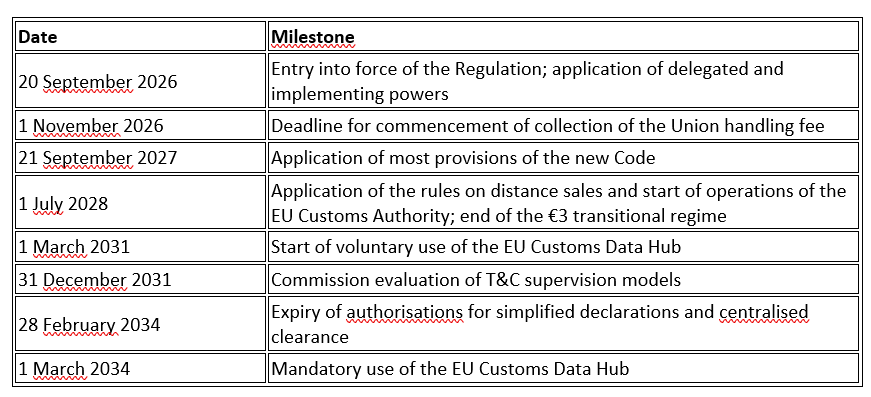
- E-commerce: new rules for low-value consignments. The customs duty exemption for the import of goods with a value not exceeding €150 has been abolished, and a customs duty of €3 per item has been in force since 1 July 2026 for consignments covered by the Import One-Stop Shop (IOSS) regime or postal consignments (until 1 July 2028, from which date the Common Customs Tariff will apply). The new Code places these changes within a broader regime that also includes a new Union handling fee for B2C consignments and makes platforms and sellers liable as importers.
New opportunities: Authorised Economic Operator (AEO) and Trust and Check trader (T&C)
The new Code substantially strengthens the advantages of AEO status (in particular, fewer controls, access to centralised clearance, priority in crisis situations and reduced comprehensive guarantees) and makes this status an essential condition for accessing various simplifications.
For companies wishing to go further, the new T&C status has been created, offering transformative benefits:
- Release of goods at the trader’s own premises, without active intervention by customs authorities;
- Possibility of carrying out certain customs controls;
- Periodic determination of the customs debt corresponding to the total amount of the import or export duties relating to all goods in respect of which they have granted release, over periods of up to 31 days;
- Deferment of payment of customs duties and reduced or waived comprehensive guarantees;
- Exemption from the transit procedure for certain movements of goods;
- Possibility of providing or making available some of the data on the goods after their release, which, combined with release at its own premises, allows the T&C trader to operate without awaiting the active intervention of customs authorities and without the need to submit all the data required for placing goods under a customs procedure in advance;
- Payment of duties in the Member State of establishment.
The T&C criteria are based on those for AEO status, supplemented by transparency requirements and real-time electronic access by the authorities to data on the movement of goods. Companies that already hold AEO status will be in a privileged position to transition to T&C status.
How to prepare in advance
Companies should act now:
- Assess eligibility for AEO status, if they do not yet hold it, as its advantages will become increasingly decisive and the application process requires prior preparation;
- Consider applying for T&C status, especially for large operators with robust information systems;
- Review internal compliance procedures (in particular with regard to tariff classification, determination of origin and customs value, assessment of the use of special customs procedures, product compliance controls, monitoring of restrictive measures and sanctions, compliance with environmental requirements, etc.);
- Review customs representation service agreements in light of the new rules on the joint and several liability of indirect representatives;
- Prepare for the digital transition to the EU Customs Data Hub, ensuring data quality and system interoperability;
- For e-commerce businesses: reassess costs, IOSS strategy and logistics models in light of the abolition of the customs duty exemption for goods up to €150 and the new Union handling fee.
Implementation timeline
Abreu Advogados has a dedicated Customs Law and International Trade team available to provide any further clarification or answer any additional questions.